
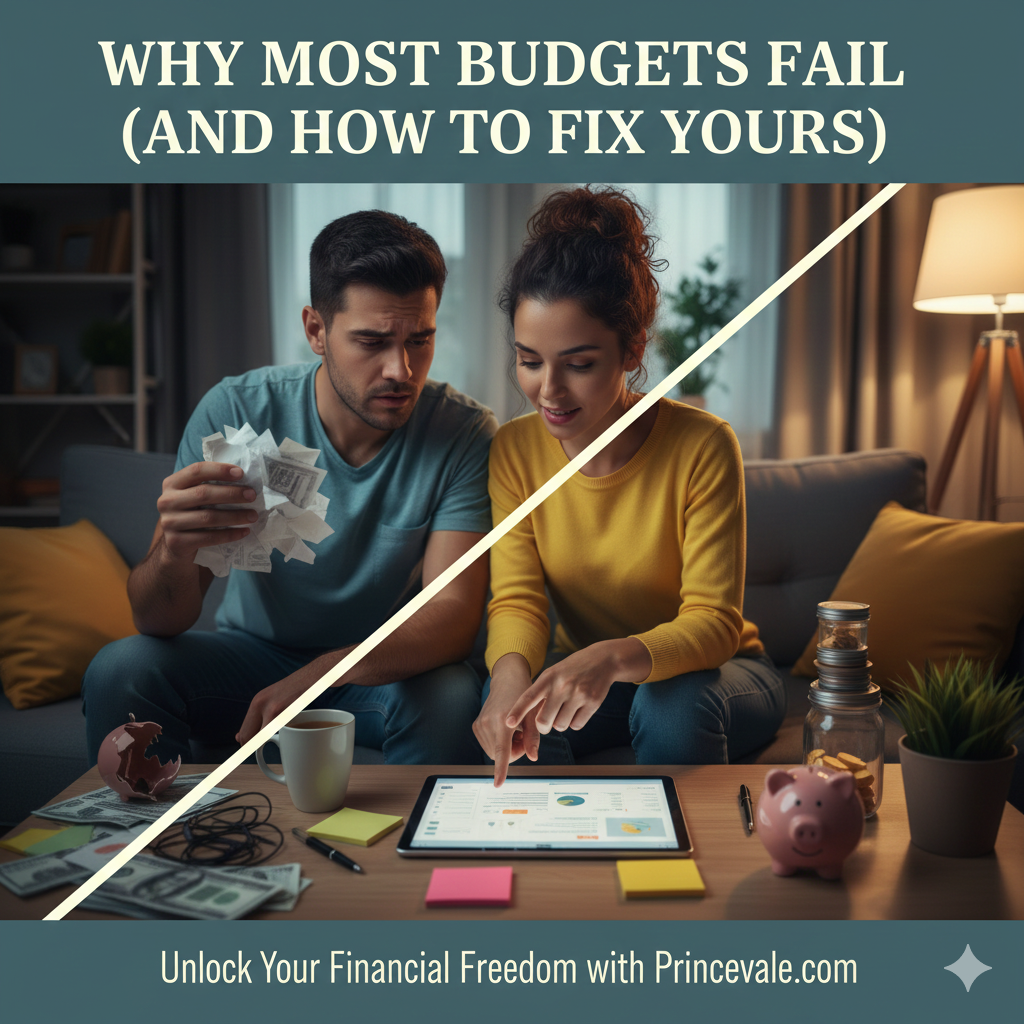
Let’s be honest:Why Most Budgets Fail; most budgeting advice is exhausting and frankly, a bit unrealistic. We’ve all been there—sitting down with a fresh spreadsheet, feeling motivated, only to abandon the whole thing three weeks later because life happened. If you’ve ever felt like a failure because you couldn’t stick to a rigid system, I have a secret for you: It’s usually the budget’s fault, not yours. Here at Princevale.com, we believe your money should serve your life, not make it more stressful. Here is why your budget is breaking and exactly how to fix it for good.
1. You Forgot the “Life Happens” Sinking Fund
Most people build a budget based on a “perfect month” where absolutely nothing goes wrong. They account for the big bills like rent and utilities, but they forget that cars need oil changes and friends have birthdays. When an unexpected $60 expense pops up, the budget “breaks,” and most people just give up entirely. This creates a cycle of frustration that makes you want to stop tracking your spending altogether. This “perfection trap” is one of the biggest hurdles we see people facing.
To fix this, you need to implement a “Sinking Fund” strategy immediately. Instead of pretending these costs don’t exist, set aside a small amount each month specifically for “miscellaneous chaos.” This ensures that when a tire goes flat, you aren’t dipping into your grocery money to fix it. By expecting the unexpected, you stop a small emergency from turning into a total financial collapse. 👉 [I highly recommend using a high-yield savings account to keep this cash separate.]

2. The “Restrictive Diet” Mental Trap
Budgeting is a lot like dieting—if you try to live on nothing but kale, you’re eventually going to eat an entire pizza. If your budget allows $0 for “fun” or “sanity,” you will eventually rebel against your own rules and overspend out of spite. This “all or nothing” mentality is the primary reason budgets fail within the first thirty days. At Princevale.com, we’ve found that sustainability always beats intensity when it comes to managing your bank account.
A sustainable budget must include a “Guilt-Free Spending” category to be truly successful. Whether it’s $10 for a coffee or $40 for a movie night, giving yourself permission to spend a small amount keeps you from feeling deprived. When you stop treating money like a punishment, you start treating it like a tool for a better life. This psychological shift is the difference between a one-month experiment and a lifelong habit. You deserve to enjoy your hard-earned money while you save for the future.
3. Your Tracking System is Too Complicated
If your budgeting system requires you to manually enter every single receipt into a complicated spreadsheet, you are probably going to quit. We are all busy, and after a long day of work, the last thing anyone wants to do is tedious data entry. This “friction” is a silent budget killer that makes you avoid looking at your bank account entirely. We want to help you find a path that feels effortless rather than like a second job.
In 2026, there is no reason to do this by hand when technology can do it for you automatically. You need a tool that syncs with your bank and does the heavy lifting so you can see your “Safe-to-Spend” balance. This allows you to make informed decisions at the checkout counter rather than just guessing. 👉 [Check out which is the favorite tool for automating your budget without the headache.] Automating your tracking is the best way to ensure you actually stay consistent.
4. Ignoring the “Subconscious Leaks”
Sometimes we fail because we don’t actually know where the money is drifting away on a daily basis. We focus on the “big bills” but ignore the $9.99 subscription for a streaming service we haven’t watched in months. These small leaks can add up to hundreds of dollars a year that could be going toward your real goals. Finding these hidden costs is the fastest way to give yourself an immediate “pay raise.”
The fix is a “Financial Audit” every ninety days to keep your accounts sharp. Go through your bank statement with a highlighter and look for recurring charges you no longer value. It’s the easiest way to “find” money without actually working more hours or cutting back on things you love. 👉 [I use [Rocket Money/Similar Tool] to scan for these leaks automatically—it’s a total game-changer.] Stopping these leaks provides instant relief to your monthly cash flow.
5. You’re Budgeting for Someone Else’s Dreams
Social media makes us feel like we should be saving for a house, or a luxury vacation, or a fancy car. If you are building a budget based on what you think you should want rather than what you actually value, you won’t stay motivated. This lack of personal connection makes the budget feel like a chore instead of a path to freedom. Your budget should reflect your unique personality and your specific life goals.
Your budget should be a reflection of your own values and nothing else. If you value travel more than a fancy apartment, your budget should show that clearly. When your money is aligned with your personal values, saying “no” to impulse buys becomes a lot easier. This intentionality is what makes a financial plan stick for the long haul. Start by defining what a “rich life” looks like for you and your family.
6. Using “Gross Income” Instead of “Net Income”

One of the most common technical mistakes is creating a budget based on your salary before taxes are taken out. If you think you have $4,000 to spend but only $3,200 hits your bank account, you are starting $800 behind every month. This leads to a constant feeling of “where did it go?” even when you aren’t actually overspending. We always recommend budgeting based on the actual cash that hits your pocket.
To fix this, look at your last three paystubs and find the average “take-home” pay. This is your Real-World Income, and it is the only number that matters for your monthly planning. By using the correct numbers, you eliminate the math errors that cause most budgets to fail. It provides a realistic foundation that you can actually build a life on. Knowing your true numbers is the first step toward real financial peace of mind.
7. Neglecting the “Cash Buffer” in Your Checking Account
Many people try to budget down to the last penny, leaving their checking account at $0 on the day before payday. This “Zero-Sum” approach is great on paper but terrifying in practice because it leaves no room for timing issues. If a bill comes out a day early, you end up paying an overdraft fee that sets you back. A “buffer” is essential for your mental health and your financial safety net.
Aim to keep a permanent “buffer” of at least $100 to $200 in your checking account that you never touch. Think of this as a mini-insurance policy against the timing of your bills and your paycheck. It prevents the stress of watching your balance hit single digits every two weeks. This small cushion makes the entire process of budgeting feel less like a high-wire act. You will breathe easier knowing that a small timing mistake won’t ruin your entire week.
8. The Lack of a Weekly “Money Minute”

A budget is not a “set it and forget it” document; it is a living, breathing thing. Many people fail because they only look at their budget once a month, which is far too long to wait. By the time you realize you overspent on dining out, the month is already over. Consistent, short check-ins are the secret to keeping your goals top-of-mind without feeling overwhelmed.
Set a calendar invite for a “Weekly Money Minute” every Sunday evening. Spend just five or ten minutes looking at your spending from the week and adjusting your plan. This keeps you engaged with your goals without making it feel like a massive, overwhelming task. Small, consistent actions lead to massive financial transformations over time. This simple habit is the #1 secret of people who actually stay on track for the long term.
Frequently Asked Questions about Why Most Budgets Fail
Q: How much should I save if I’m already broke? A: Even $5 a week matters. The goal isn’t the amount; it’s the habit of putting something aside. Once the habit is there, you can increase the amount as your income grows through our tips here at Princevale.com.
Q: Which is better: A spreadsheet or an app? A: The “best” one is the one you will actually use. If you love data, use a spreadsheet. If you want to “set it and forget it,” use an automated app.
Q: How often should I check my budget? A: At first, check it every two days. Once you’re in a rhythm, a “Weekly Money Minute” is usually enough to keep things on track.
The Bottom Line: Your Budget is a Tool, Not a Cage
At the end of the day, remember that a budget isn’t a math problem you have to solve perfectly—it’s a map for the life you want to lead. If you’ve struggled in the past, give yourself permission to start over today. The most successful people aren’t the ones who never overspend; they are the ones who get back on track the very next morning without beating themselves up.
Ready to fix your finances for good?
- Step 1: Download a tracking app or grab a notebook today.
- Step 2: Identify your top 3 “Money Leaks.”
- Step 3: [Click here to see the Princevale ‘Broke-Budgeting’ Toolkit] and start your journey to financial peace!